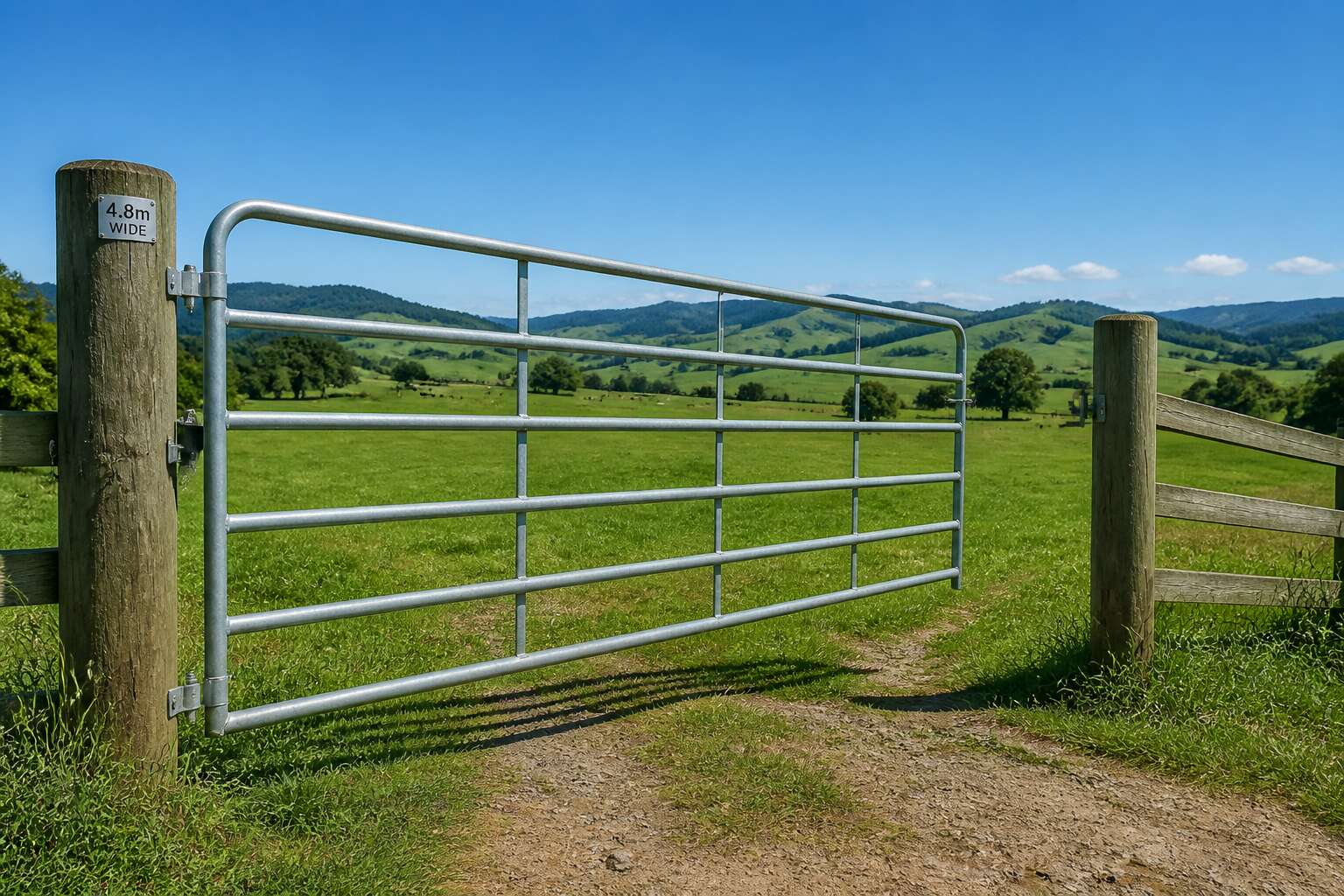
Evaluating Heavy-Duty Farm Gate Specifications
Key Measurements and Load Ratings
Farmers often underestimate the cost of a collapsed entrance, not just in repairs but in lost time. When I evaluate farm gates 4.8 meters wide, the actual challenge lies in the engineering, not the span. A gate that long acts as a lever, placing immense torsional stress on the hinges. If the frame is not triangulated properly, the structure will sag within a season of heavy use. You must inspect the bracing pattern, specifically the corner gussets, to see if they handle the twisting force.
The load rating is the true test of durability. A 4.8 meter gate for cattle movement needs a different specification than one used for occasional vehicle access. I always tell clients to look for a high-tensile steel grade, such as S355, which offers superior yield strength. The hinge post is equally critical; the concrete footing must be deep enough to resist frost heave and lateral pressure.
Here is a quick breakdown of what I check on site:
– The wall thickness of the main frame tubing, typically 3mm or 4mm.
– The diameter of the hinge pins, which should exceed 20mm to prevent shearing.
– The quality of the galvanisation, measured in microns for coastal corrosion resistance.
Gate alignment is everything. If the drop rod catches cleanly, the installation is sound. Remember that a 4.8 meter gate is only as good as its weakest component, so scrutinise the weld quality. A poor weld at the base joint will fail long before the steel fatigues. This meticulous approach saves you from replacing an entire unit. I have seen cheap farm gates 4.8 bend like paper under wind load, so do not skip the quality control checks.
Understanding Steel Gauge and Tensile Strength
“Any fool can make a gate that looks right,” a Boerboel breeder in the Free State once told me, “but it takes a metallurgist to make one that stays right.” He was pointing at a farm gates 4.8 span that had twisted into a pretzel after one Karoo storm. He was right. The gap between a gate that merely spans an opening and one that survives a decade of abuse is purely mathematical.
The steel gauge is your first line of defense, but most buyers confuse thickness with strength. A 3mm wall thickness in mild steel will flex like a willow branch under a 4.8 meter load, while the same 3mm in S355 high tensile steel will hold its line. The tensile strength, measured in megapascals, dictates how much bending force the frame can absorb before permanent deformation. You want a yield strength above 355 MPa, anything less and you are buying a very expensive piece of decorative art.
When you inspect the main frame, bring a set of callipers, not just your eyes. The galvanisation layer, measured in microns, is where coastal farmers win or lose. The salt air in Mossel Bay will eat through a cheap zinc coating in 18 months. Check the weld seams for porosity, those tiny bubbles indicate gas pockets that will crack under torsion.
Here is what separates a professional install from a backyard job:
– The cross bracing must form a perfect X, not a lazy Z, to distribute torsional stress.
– The hinge plate should be welded to the post, not bolted, to prevent lateral movement.
– The drop rod needs a steel collar, not a simple hole, to stop wear over time.
The true test of a farm gates 4.8 is not how it looks on the showroom floor, but how it behaves after 500 open and close cycles. Rust is a thief, but poor steel gauge is an accomplice. If the tensile strength is not stamped on the frame, walk away.
Comparing Galvanized vs. Powder-Coated Finishes
When a farm gates 4.8 swings open over a dry Free State track, the finish determines whether that gate outlasts your mortgage or fails within three winters. Galvanized coatings, typically 85 to 120 microns of zinc, offer sacrificial protection. Scratches heal themselves as the zinc oxidizes. Powder coating, by contrast, provides a tougher surface against scratches and UV fade, but any breach in the film invites rust to creep underneath. I have seen powder coated gates fail beautifully in Mpumalanga mist belts. The decision is not aesthetic; it is environmental.
Here is what I inspect before specifying:
– Hot dip galvanizing, not electroplating, for real thickness.
– A powder coat over galvanized steel, known as duplex systems, for the best of both.
– Edge coverage, where powder coating often thins to 40 percent of the flat surface rating.
Choose your finish like you choose a farm gates 4.8: for the specific weather it must endure.
Welded Mesh vs. Solid Panels for Livestock
The first thing a farmer notices about a gate is often the sound it makes. A dull, heavy thud speaks of solid construction. A tinny rattle suggests something less trustworthy. When evaluating heavy duty farm gates 4.8, the debate between welded mesh and solid panels is a practical one. It is about what you see through the gate, and what you cannot.
Standing in the Karoo wind, you quickly learn the value of a solid panel. It blocks the dust, offers privacy for your house yard, and stops a nervous sheep from trying to squeeze through a diamond mesh. For livestock, the visible barrier of a solid panel can be more calming. They see a wall, and they stop testing it.
Welded mesh, on the other hand, remains a firm favourite for many operations. The open structure allows you to inspect the herd from a distance, checking for illness or injury without walking the paddock. But the choice requires a close look at the specific design:
- Wire diameter and spacing dictate strength against impact from large animals.
- Panel framing depth influences resistance to sagging over long spans.
- Weld points need to be secure to prevent fatigue cracks from constant swinging.
These details determine if the gate lasts a decade or a season. For this reason, many specifiers choose a farm gates 4.8 with mesh that is heavy enough to hold a bull, yet open enough for airflow. A solid panel gate, however, catches the full force of a Free State thunderstorm. The wind load on a solid sheet can be substantial, stressing the hinges and the frame. That unseen pressure is the true test of the specifications. Weighing the visibility against the wind resistance, the choice often comes down to the temperament of the animals and the location of the fence line. The correct gate is the one that does its job quietly, season after season, without drawing attention to itself. It is a simple object, but its daily function is a constant in the rhythm of the farm.
Identifying the Right Hinge and Latch Hardware
There is a moment on every farm when the gate’s hinges announce their opinions. A squeal here, a sag there. The hardware carries the entire weight of your decision, and a farm gates 4.8 with excellent steel means nothing if the hinge pin is a bent nail in disguise.
Look for forged steel hinges with greasable pins. The latch deserves equal suspicion. A simple hook might work for a quiet sheep camp, but a robust locking mechanism prevents the escape artist among your cattle.
- Check the hinge depth matches the gate frame thickness.
- Ensure the latch spring returns with a snap, not a whimper.
- Verify the cotter pins are removable for future maintenance.
These details separate a daily convenience from a wrestling match. The true test is swinging the gate one hundred times. Your arm will know.
Selecting the Ideal Gate for Your Agricultural Operation
Fencing Compatibility and Post Spacing
Most gate failures trace back to the posts, not the gate. A farm gates 4.8 unit spans a wide opening, and that span demands serious lateral support. The fence line must align with the gate frame, otherwise you will fight the hinges each time you open it.
Post spacing is the usual problem. Posts set too far apart make the gate sag. Too close, and the hinges lack proper anchoring. When you select farm gates 4.8, the end posts need deep burial, concrete collars, or a proper raking system. The fence height should match the gate’s top rail to keep tension even along the span.
A few variables deserve attention:
– The gate’s operating clearance. Leave at least 100mm on each side.
– The fence’s top rail height. It should line up with the top bar.
– The prevailing wind direction, which adds stress to the gate leaf over years.
The post carries the gate. The fence stabilises it. Both need to work as one unit.
Driveway vs. Pasture Access: Sizing Considerations
Most farmers only discover the difference between a driveway gate and a pasture gate after the first repair bill. Driveway traffic demands swing clearance, towing angles, and a straight approach. I have seen a farm gates 4.8 unit installed for a driveway that later struggled with a tractor and front loader. The width was correct. The hinge placement was not.
- Driveway: measure the widest vehicle, add 600mm per side for mirrors and mud.
- Pasture: align the gate leaf with the cattle path, not the fence line.
Pasture access is about flow. Livestock bunch up, so a narrow gate creates bottlenecks. The farm gates 4.8 works well for both, but your decision starts with traffic type. Driveway duty demands regular hinge cycles. Pasture duty demands a gate that swings shut on its own. Size accordingly.
Manual, Automatic, or Remote-Controlled Options
One hundred hours. That is what an average farmer spends each year moving between cab and gate. The choice between manual, automatic, and remote controlled systems defines daily rhythm. A farm gates 4.8 installation supports each mechanism, but only one matches your routine.
Manual operation demands no power and no electronics. It offers direct feedback and absolute simplicity. Automatic operation brings a solar powered actuator that opens on a timer. Remote control places a transmitter in your vehicle, so you never leave the seat.
- Manual suits low traffic and short distances.
- Automatic suits scheduled feeding routes.
- Remote suits wide pastures with multiple access points.
Labour availability shapes the decision. Power source matters. Swing frequency per hour changes the requirement. The farm gates 4.8 remains the fixed point, while the control system adapts to your operation’s true character.
Biotic and Chemical Resistance in Corrosive Environments
Salt spray, ammonium hydroxide, phosphoric acid. These compounds corrode steel silently, and South African coastal farms know this intimately. The Atlantic and Indian Oceans drive chloride particles into gate hinges, while inland feedlots generate ammonia fumes that attack zinc protective layers.
Biotic and chemical resistance are separate engineering problems. Fungal spores and livestock waste promote crevice corrosion where two metal surfaces overlap. The farm gates 4.8 eliminates these traps through welded connections and sealed joint cavities. Fasteners receive the same corrosion protection as the frame, and the design sheds moisture rather than trapping it against load bearing points.
Consider your corrosive environment honestly:
- Coastal wind exposure within 5 km of the tide line
- Dairy washdown areas with constant moisture and chlorine
- Fertiliser sheds where ammonia concentrates in enclosed air
The farm gates 4.8 will outlast its environment when these specific pressures shape your material choice.
Budgeting for Long-Term Durability
The cheapest farm gate becomes the most expensive purchase on your property within three seasons. I have watched too many operations pay for the same infrastructure twice. Selecting the ideal gate for your agricultural operation means weighing the purchase price against the service life you expect.
The farm gates 4.8 sits at a practical middle ground. It spans typical livestock and implement widths without demanding excessive foundation work. Budgeting for long-term durability requires a clear view of the full cost picture:
- Foundation preparation and concrete work
- Professional installation or the value of your own labour
- Replacement frequency under your specific conditions
The farm gates 4.8 fits this calculation when you choose based on operational demands rather than the invoice alone.
Custom Configurations for Sloped or Uneven Terrain
Uneven ground exposes the weaknesses in any gate system. A standard symmetrical frame twists over time when one corner carries the load. The farm gates 4.8 allows custom hinge mounting points and diagonal bracing to match the gradient of your paddock. This is where the value appears: when the land fights against a straight line.
For slopes that drop more than 150mm across the opening, consider these adjustments:
- Offset hinge plates that shift the pivot point to account for the fall
- Adjustable drop rods that lock into a receiver set deeper into the ground
- Reinforced corner gussets on the downhill side to resist racking
Assemble the frame on site to measure the angle between the hinge post and the latch post. Never assume level ground, especially on the highveld where seasonal runoff alters the surface each year. A farm gates 4.8 built for your terrain will outlast a standard unit.
Installation Best Practices for Secure and Reliable Performance
Preparing the Ground and Setting Posts Correctly
Most farm gates 4.8 failures begin at the moment the first post enters the soil. A gate rated for heavy livestock will still sag if its anchor shifts in loose topsoil, so installation starts with the ground itself. Assess soil type first, because clay, sand, and decomposed dolomite each require different footing depths. Dig below the active root zone, add a gravel base for drainage, and brace the post with concrete that spreads beyond the hole’s widest point.
When setting posts, pay attention to a few non-negotiable details:
- Keep the hinge post and latch post at identical heights to avoid forcing the gate.
- Plumb each post with a spirit level before the concrete begins to cure.
- Use a mix with workable slump so it flows around the post without voids.
- Check alignment across the full opening before the concrete hardens.
For a farm gates 4.8 span, set a 200 mm post at least 900 mm deep. That simple decision decides whether the gate remains square for decades.
Aligning Hinges and Latches for Smooth Operation
The difference between a farm gates 4.8 that swings freely for twenty years and one that binds within a year often comes down to three millimeters of hinge placement. It is a small margin, but it decides everything. The hinges carry the full weight, and the latch receives the daily shock of closing.
Alignment begins with the hinge assembly. Each hinge leaf must sit flush against the post face, with all bolts torqued to the same value. A single loose bolt introduces play that compounds over repeated openings. For the latch side of a farm gates 4.8, the catch must align with the latch bolt, both horizontally and vertically.
- Check the top and bottom hinges share the same vertical axis.
- Confirm the gate rests level when closed without lifting the latch post.
- Adjust the latch striker to meet the bolt at 90 degrees.
Fastening Techniques for Maximum Structural Integrity
Fastening a farm gates 4.8 requires precision. A gate’s lifespan depends on how its brackets transfer load into the post. Over-torquing a bolt crushes the paint layer, while under-torquing lets vibration loosen the joint. For South African conditions, where temperature swings stretch steel, use hardened washers under every nut.
- Clean all contact surfaces with a wire brush to remove mill scale.
- Apply anti-seize compound to stainless bolts only.
- Torque in three increments, crossing the bracket diagonally.
- Re-torque after seventy-two hours of settling.
Stud welding on the post face offers an alternative to through-bolts when access is limited. Verify weld penetration before hanging the farm gates 4.8. A fillet weld lacking fusion fails without warning. Use grade 8.8 bolts for all pivot points, and never reuse a bolt that has exceeded its yield point.
Wind Load and Swing Clearance Adjustments
Wind load on farm gates 4.8 shows itself during the first thunderstorm. A 2.4 meter panel, caught broadside, can shear a hinge pin. Swing clearance is the first defense. Measure the open arc on both sides of the post. Leave 150 millimeters past the latch point, add 50 more on sloped ground.
Install the gate to open into the prevailing wind. Gusts press it against the stop, locking it in place. Opening away from the wind invites slamming. I recommend setting hinge pins with a slight rake so gravity returns the gate. Consider these adjustments before pouring concrete:
- Set hinge pin rake to 8 degrees.
- Add a drop rod for gusty sites.
Electrical Safety When Integrating Automated Sensors
Installing farm gates 4.8 requires precision at the post-setting stage, but the hidden details often determine the service life. A common oversight is the reaction to shifting soil moisture, common in the Highveld. If the concrete collar around the post is flush with the ground, water pools at the base and accelerates corrosion. I prefer to taper the concrete away from the post, creating a small crown that sheds water. This simple drainage detail prevents premature failure of the hinge post.
The electrical side becomes critical when you integrate automated sensors. Most gate motors fail not from mechanical stress, but from voltage surges caused by nearby lightning strikes. You must install a dedicated earth spike at least one meter from the gate frame. The sensor wiring needs to run in a separate conduit from the motor power cable, otherwise the signal gets corrupted by electromagnetic interference.
For sensor placement, the alignment matters more than the sensor brand. When mounting the photoelectric beam on farm gates 4.8, ensure the brackets are plumb and level. A misaligned sensor on a windy day will trigger false closures, leaving you to manually reset the system. I always check the wiring connections for tension relief. A loose cable that rubs against the gate frame will eventually expose the copper core, creating a short circuit risk.
Consider these essential electrical checks before commissioning the automation:
- Verify the sensor beam is shielded from direct sunlight to prevent false triggers
- Test the manual release mechanism before installing the motor housing
- Confirm the limit switches are set to match the gate’s physical swing arc
- Apply dielectric grease to all terminal blocks to resist moisture ingress
Grounding the gate frame itself is often overlooked. The steel structure can carry a static charge, which confuses the control board. I run a separate earth conductor from the gate leaf to the ground spike, bypassing the motor entirely. This isolates the safety system from the power supply, creating a more stable operating environment.
Testing and Calibrating After Initial Setup
Most installations fail in the first month because poor welding is rare. The culprit is usually an unverified gate under actual load. Once the final bolt is tightened, the process shifts. Performance testing on farm gates 4.8 demands patience, not guesswork.
I start by cycling the gate manually. That reveals binding hinges or a sagging leaf. Then I engage the motor and watch the acceleration curve. A gate that jerks open has misaligned travel. Calibration follows each adjustment. I measure the open and close positions against the physical stops, then reprogram the controller.
Here is the sequence I use:
- Set the limit switches with the gate in neutral position
- Run three full cycles, checking for drift
- Adjust the clutch torque to suit wind conditions
- Verify the sensor beam alignment after each cycle
Calibration is not a one-time event. The Highveld’s temperature swings alter gate clearances. Rechecking farm gates 4.8 after a week of use catches problems early.
Maintenance and Upkeep to Extend Gate Lifespan
Routine Inspection of Weld Points and Joints
A farm gates 4.8 structure endures tremendous stress, yet the welds and joints often go unnoticed until they fail. A hairline fracture, barely visible to the naked eye, can compromise the entire frame within months. When you inspect, look for rust trails or flaking paint along the weld seams. These are the first whispers of structural fatigue.
Routine inspection of weld points and joints should happen quarterly, or after any severe storm or impact. Do not assume that a galvanized coating hides problems forever. In South Africa’s harsh sun and dusty conditions, the protective layer degrades faster than many owners expect.
Your inspection routine should include:
– Check for cracks or pitting at the weld toes
– Tap the joints with a hammer and listen for a dull thud
– Examine the hinge plates for any twisting or deformation
– Look for gaps where the gate frame meets the bracing
A simple hand test works well. Run your fingers along every joint to feel for sharp edges or lifted metal. Loose welds create a distinct vibration when the gate swings, and this sensation travels up the frame. Ignoring these signs leads to sagging, misalignment, and eventual catastrophic failure.
The truth is that a farm gates 4.8 installation only remains reliable if you treat its joints like the lifelines they are. The elements work against you daily, and the welds are the first line of defense. A few minutes of attention now saves you from a costly replacement later. The silent, creeping deterioration is the enemy, and your eyes and hands are the only tools that truly matter.
Lubrication Schedule for Hinges and Rollers
Lubrication is the unglamorous task that keeps a farm gates 4.8 swinging true. Without it, hinges and rollers develop a gritty resistance that spreads to every moving part. A dry bearing fails faster than any weld, and that deterioration often goes unnoticed until motion becomes impossible.
I prefer a calendar approach. Mark the first Monday of each month for light oiling, and a deeper service every three months. In the Karoo, where dust is extremely abrasive, shorten that interval. For roller tracks, silicone spray works; for hinge pins, use a lithium-based grease.
- Monthly: wipe debris and oil hinge pins
- Quarterly: clean roller races and repack grease
- After storms: flush out grit and reapply
That schedule has kept my farm gates 4.8 operational for years without a seized joint. The cost is a few minutes and a rag.
Rust Prevention and Touch-Up Coating Methods
A farm gates 4.8 loses its strength silently. Rust begins at a scratch and spreads outward. In the Highveld, about 70% of steel degradation starts with unchecked surface damage. Salt-laden coastal air accelerates the same process much faster.
Prevention means catching those breaches early. I check my panels every time I pass through. A scrape from a hoof or a trailer chain leaves bare steel exposed. I keep zinc-rich primer and a matching topcoat in the workshop. When I spot a nick, I sand with 120-grit, wipe with mineral spirits, and brush on a thin layer.
For deeper corrosion:
- Grind away loose scale until bright metal appears
- Apply a rust converter and allow full drying
- Add two coats of primer, then two of topcoat
Repeating this every six months stops the creeping corrosion that weakens joints. That hour of work extends the lifespan of your farm gates 4.8 by a decade.
Correcting Misalignment and Sag Over Time
Misalignment in farm gates 4.8 rarely appears suddenly. A dragging corner or a latch that no longer meets its keeper is the first sign. The cause is usually post movement, not gate failure. Clay soils in Gauteng swell and shrink with the seasons, shifting the entire frame.
When I notice sag, I first check the hinges. A worn pin adds play that no amount of tightening can fix. Then I look at the diagonal brace. The farm gates 4.8 rely on that brace to hold the rectangle square. If it has loosened, I reset it and re-tension the turnbuckle.
For persistent droop:
- Support the gate at its midpoint before adjusting anything
- Loosen the hinge bolts and shim the top hinge outward
- Re-tighten and test the swing arc
That process restores clearance and keeps the gate tracking true. Catching the problem early prevents weld fatigue at the corners!
Replacing Worn Components Versus Full Gate Overhaul
Farm gates 4.8 with a decade of service often force a decision. Replace the worn bits or commission an entirely new gate? I have found that most gates do not need a full overhaul. The frame remains serviceable, while the hardware wears out first. Consider the hinge pins, latch springs, and roller bearings as consumables.
- Check for play in the hinge pins; a loose pin allows sag.
- Look at the latch keeper; a worn notch affects closure.
- Inspect the brace turnbuckle; if stripped, it can be replaced alone.
Only when the main frame shows corrosion or a cracked weld should you consider a full replacement. And even then, consider the cost against buying fresh. Rebuilding a frame with new steel often costs more than purchasing farm gates 4.8. But a well maintained gate, with swapped components, can outlast its original warranty by years!
Seasonal Considerations for Extreme Weather
South Africa’s weather does not compromise, and neither should your maintenance routine. Temperatures swing from scorching Highveld afternoons to damp coastal winters, and each season attacks metal differently. For farm gates 4.8, UV exposure degrades seals and paint faster than rust, while winter morning dew creeps into every crevice. The result is accelerated wear that shows up as stiff hinges or misalignment.
Set a seasonal checklist that matches your climate:
- Before summer, inspect rubber buffers and lubricate with a UV-resistant grease.
- After the rainy season, flush hinge barrels with a water-displacing spray.
- In autumn, clear debris from the bottom rail to prevent moisture trapping.
These steps take a few minutes but prevent slow deterioration. Farm gates 4.8 that receive this seasonal attention will swing freely long after neglected units have seized.




0 Comments