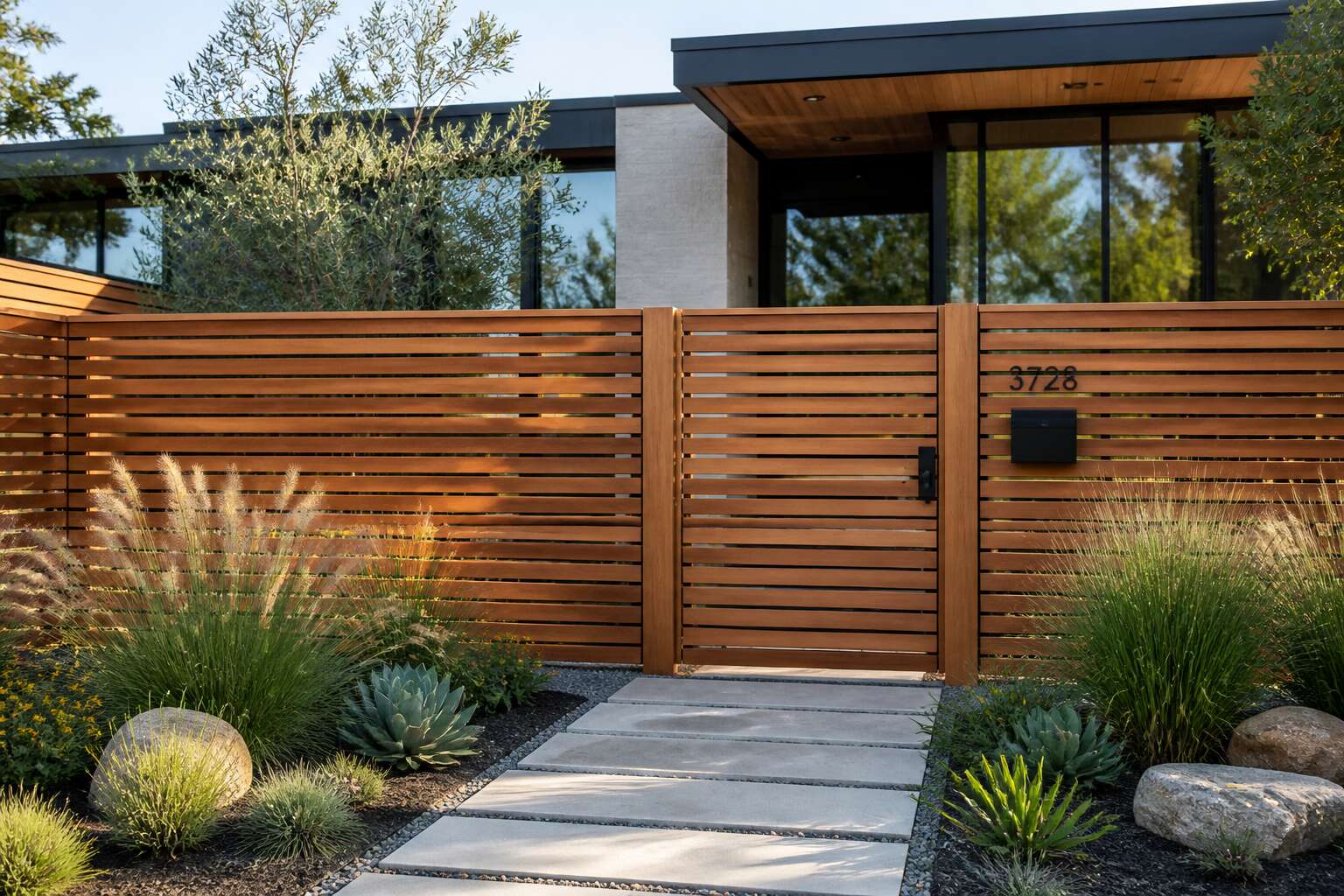
Contemporary Fencing Materials
Sleek Steel and Aluminum Panels
Steel and aluminum panels have quietly reshaped the perimeter security conversation in South Africa. A recent industry survey noted that over 60% of new residential developments in Gauteng now specify metal panel systems instead of conventional brick or timber.
That shift makes sense. Powder coated aluminum resists coastal corrosion, while galvanized steel holds up under harsh Highveld sun. Both materials allow for slim profiles and clean sightlines. In fact, a well detailed panel system can read as a design feature rather than a barrier. For a modern fences design, the key is balancing privacy with light.
- Horizontal louvers create partially open screening
- Perforated sheets offer pattern and airflow
Slatted steel panels, for instance, break up long boundary lines without feeling fortress like. The material weight also matters. Aluminum is lighter and easier to install, but steel provides greater impact resistance. Your choice depends on the site and the statement you want to make for your modern fences design.
Engineered Wood and Composite Alternatives
Engineered wood and composite alternatives are changing the perimeter conversation. In South Africa, where termites and moisture test every boundary, these materials resist decay far longer than untreated timber. A recent industry test showed composite boards surviving five times the wet cycles.
For a modern fences design, compressed bamboo fibres and recycled HDPE create a surface that never splinters and never rots. Some boards even carry a coextruded shell, a protective layer against UV rays and scratches. The feel is warm, the maintenance is minimal.
The installation matters just as much. Hidden fasteners and clipped rails turn the fence into one seamless plane. Consider your priorities:
- Engineered wood offers the organic grain.
- Composites offer uniform performance.
That is where modern fences design moves beyond enclosure into considered living.
Glass and Mixed-Media Combinations
Glass admits light while denying passage, which makes it a compelling threshold material. In South Africa, laminated panels with low iron content reveal the Highveld sky without the green tint common to standard float glass. Frosted finishes soften the boundary into a suggestion rather than a declaration.
Mixed media gives these surfaces a graver context. Corten steel frames rust on their own schedule, and rough stone pillars hold deep shadow. The contrast between transparency and weight draws the eye along the line of the fence.
Common combinations:
- Frameless glass sections anchored between masonry pillars.
- Vertical timber battens set before translucent panes.
- Reeded glass paired with black steel posts.
These assemblies push modern fences design toward a layered quietness, where light itself becomes the material and the fence recedes into the landscape.
Sustainable and Recycled Materials
When sustainability becomes the starting point, the fence carries its history in the grain. Recycled aluminium from scrap yards and reclaimed hardwood from demolished buildings bring a density that virgin materials lack. In South Africa, where landfill pressure is real, embodied energy becomes part of the design conversation.
The materials earning a second life are worth listing:
- Recycled HDPE lumber, which resists termites and never needs painting.
- Recovered meranti from old roof trusses, re-sawn into vertical battens.
- Crushed concrete or glass aggregate packed into steel gabion baskets.
I have seen these assemblies hold up for decades, and the savings are real! They pull modern fences design away from disposability. A fence made from recycled content does not age into neglect, it weathers into character. Manufacturers guarantee recycled products for twenty years or more, which changes the cost of ownership entirely.
High-Tech Smart Fence Options
Security technology has changed what a boundary can do. In Johannesburg, homeowners now pair motion sensors with perimeter detection that alerts their phones before a gate even opens. These systems integrate with existing walls, making a static barrier responsive.
Smart fencing options are expanding fast:
– Solar powered sensors that charge through Highveld winters.
– Wi-Fi enabled cameras with night vision and two way audio.
– Remote controlled locks that log every entry.
The data from these systems is the real value. A fence that reports its own status removes guesswork. For modern fences design, the boundary becomes part of the home’s digital ecosystem. That shift is practical, not futuristic.
Design Styles and Aesthetics
Minimalist and Linear Profiles
Most South African neighbourhoods have enough visual noise without your fence adding more. Minimalist profiles offer the cure: flat horizontal slats that guide the eye along the boundary instead of pointing every neighbour toward the sky.
The clean lines reduce visual clutter. A fence with fewer angles gives the garden more open space. My own preference is timber battens set at uniform intervals. The spacing repeats with precise consistency. Nothing distracts!
Consider these linear profiles for their restraint:
– Horizontal slats with narrow gaps
– Board and batten verticals in one tone
– Frameless panels with flush joints
Modern fences design thrives on geometrical honesty. Less profile, more presence.
Horizontal Slats vs. Vertical Lines
The fence imposes a rhythm on the boundary. In modern fences design, that rhythm is everything. Horizontal slats hold the eye at a steady level. Vertical lines pull it upward, toward the overcast sky. In South African suburbs, the choice is a question of temperament. The horizontal profile is quiet. It encourages calm. The vertical line insists. It suggests vigilance.
Consider how each reads against the highveld light:
- Horizontal slats flatten the view, widening narrow stands.
- Vertical boards add height, making a small yard feel guarded.
There is a quiet authority in the horizontal fence. I have watched it hold its ground through a Highveld storm. It does not challenge the street. It repeats its rhythm without interruption. Vertical lines carry a different vigilance. They stand row after row, altering the way shadow falls across the garden floor. Both belong to the modern fences design vocabulary. Your light and your nerves determine the direction.
Geometric Patterns and Laser-Cut Screens
Laser cut screens have changed how the South African boundary works. The old brick wall sealed the property off. The geometric panel holds the line while allowing light through. The pattern sits between the street and the garden, filtering both view and afternoon sun.
Common motifs in modern fences design include:
- Zulu inspired chevrons that sharpen the late light
- Star patterns drawn from Cape Malay architecture
- Simple grids that break a flat steel face
Each pattern casts a shadow across the paving. That shadow is as important as the panel itself. The steel provides security; the pattern provides the aesthetic. Homeowners choosing modern fences design get privacy without the weight of a solid wall. The yard stays visible from the street, but only in fragments. That partial view is often enough.
Integrated Lighting for Night Appeal
When dusk settles, most fences vanish into black. Integrated lighting changes that. A well placed lamp turns the boundary into a night feature. The same panel that filters daylight now casts a pattern onto the paving. This is where modern fences design earns its keep after hours. Up-lights graze the steel surface from below, creating a solid, glowing plane. Down-lights from the roof line soften the wash and guide footsteps. For a bolder effect, backlighting between double panels throws the motif into sharp silhouette, though it needs a deep cavity. Common installation methods:
- Recessed ground lights aimed at the panel base
- Wall mounted fixtures with a 30 degree tilt
- In-ground strips along the fence line
Each method changes the mood and the visible geometry. I find the backlight option worth the cost. This approach suits modern fences design. South African evenings demand low maintenance. LED strips handle the climate well!
Bold Colors and Textural Finishes
Bold colors redefine what a boundary can say. A burnt orange panel against a grey sky turns a fence into a focal point, while a deep olive green blends into the veld without disappearing. In South Africa, UV resistant coatings are non negotiable, and the best modern fences design accounts for this from the start.
Textural finishes add depth that color alone cannot. A sandblasted surface softens reflections, while a brushed finish seems to change with the light. Powder coating gives a consistent, durable layer that resists rust. Some manufacturers now offer embossed woodgrain on aluminium, which provides warmth without timber upkeep. Common options:
- Brushed metal for fine, directional sheen
- Sandblasted for a matte, tactile feel
- Powder coated for bold color and chip resistance
Each finish alters how the fence interacts with sun and shadow. The choice affects maintenance, longevity, and visual weight.
Functional Innovations for Modern Living
Privacy Solutions with Adjustable Louvers
In South Africa, where the sun’s angle shifts with the seasons, a static fence offers limited reprieve. I find adjustable louvers provide a practical adjustability, letting you govern light and visibility without sacrificing ground. You control the view from your braai area, turning a neighbour’s glance away with a simple rotation.
These blades pivot on robust hinges, responding to a manual turn or an automated system. Closed fully, they form a solid barrier; opened, they let the breeze pass. Consider these settings:
- A high tilt blocks afternoon glare
- A low tilt reveals the garden bed
- A closed position grants total seclusion
This innovative approach defines a current direction in modern fences design, merging control with elegance. The fence becomes a useful tool for daily comfort, tuned to your requirements each day.
Automated Gates and Security Features
In South Africa, the perimeter is where security starts. But a fence that blocks a view does nothing if the gate is the weak point. That is why automated gates have become central to modern fences design. They open and close while integrating with the broader security system.
I have seen homeowners replace static gates with sliding motors that respond to fingerprint access or remote codes. Intercoms link to your phone, allowing you to verify a delivery before buzzing someone through. Some systems include backup batteries for load shedding. Others use vehicle sensors that detect a car approaching from either side.
Consider these security features when planning an automated gate:
- Tamper alarms that trigger on forced movement
- Photocells that reverse the gate if a person or animal crosses the path
- Manual release in case of power failure
These additions turn the entrance into a controlled point, not a gap in the boundary.
Acoustic Noise-Reduction Barriers
Traffic noise is a common complaint in suburbs along major arteries. Acoustic barriers solve this by combining dense cores with sound absorbing facings. In modern fences design, the full assembly matters more than individual panels. In my experience, the difference often comes down to seam quality. Perforated outer skins break sound waves before they hit the solid backing. A narrow gap lets noise pass as if the panel were not there.
Several acoustic panel options exist for different conditions:
- High mass vinyl barriers for dense urban zones
- Recycled rubber panels that handle rain without swelling
- Perforated metal screens with mineral wool backing
Some systems include ventilation slots to keep air moving. That gives you sound control without closing off the garden.
All-Weather Durability and Coating Systems
According to the South African Weather Service, UV levels reach extreme index 11 on most summer afternoons. That is why modern fences design depends on coating systems as much as structural logic. A powder coat over hot dip galvanising survives coastal salt and Highveld UV, but only if the surface was properly prepared. I have seen immaculate panels fail because the finisher skipped the etch primer. For durability, the sequence matters.
- Anodised aluminium needs no paint but shows fingerprints.
- PVDF coatings hold colour for decades.
- Zinc rich primers stop rust at the source.
Some owners now request ceramic infused topcoats, which resist chalking and fading. Others prefer polyurethane finishes for their flexibility against thermal movement. The real question is what your fence will endure. The answer is always more than you expect.
Space-Saving and Flexible Layout Ideas
Modern fences design must respond to tighter suburban footprints. A fixed boundary wastes potential. Instead, consider a fence that moves with your day. Sliding panels can tuck against a wall to open the yard for a braai, then close for privacy. Foldable gate sections double as a trellis for climbing plants. Modular planter boxes attach to railings and can be repositioned seasonally. The beauty of this approach is that the fence becomes a tool, rather than a static barrier.
Key flexible layout ideas:
– Recessed tracks that let panels stack like curtains
– Hinged sections that fold into a bench when open
– Adjustable height inserts for temporary shade or windbreaks
These options require careful hardware selection and regular track cleaning, but they transform how you use every square metre. Modern fences design is no longer static. It adapts!
Integrating Fences with Landscape
Planting Complements and Vertical Gardens
Fences rarely stand alone in a well-designed plot. Planting complements soften the hard lines of a boundary, while vertical gardens turn a simple barrier into a living screen. In South Africa, where indigenous species like spekboom thrive, integrating greenery into a fence reduces heat gain and supports local biodiversity. A modern fences design often uses modular trellis systems that support climbers without damaging the structure. These systems allow for seasonal colour changes and natural privacy. Consider the following planting choices for your boundary:
- Creeping fig for dense coverage on masonry or steel.
- Star jasmine for fragrance and evergreen screening.
- Wild grape for fast-growing shade on horizontal wires.
Vertical gardens take this further by mounting soil pockets or hydroponic panels directly onto the fence. They require irrigation and drainage, but they transform an ordinary perimeter into a lush, productive surface. The key is to balance the weight of the soil with the fence’s load capacity. A modern fences design with integrated planters can hide unsightly bolts or seams. When the planting matures, it creates a microclimate that cools the surrounding area. This approach works well for narrow plots where ground space is limited.
Ground Cover, Gravel, and Border Details
Survey any boundary and the eye drops to the ground line. That strip where fence meets earth determines whether a perimeter feels finished or forensic. Landscape architects estimate that 30% of perceived fence quality comes from its base treatment, yet it receives a fraction of the design attention! In South Africa, where storms test drainage, this zone needs finesse.
Gravel, in my experience, drains quickly and contrasts cleanly against steel or timber. But gravel without restraint turns into a scattered mess. A galvanised edging rail, set flush with the surface, holds the aggregate in place.
Living ground covers offer a softer route. Dwarf mondo grass or resilient vygies form a mat that suppresses weeds and shields the fence base from splashback.
Consider these ground plane options:
- Crushed quartz for a luminous finish
- Umbrella rock for texture
- Creeping thyme for fragrance
A modern fences design earns its polish from such border details.
Water Features and Reflection Pools
South African gardens rarely pair water with fence lines, yet the combination transforms a boundary into a living installation. A reflection pool set along a steel fence doubles the visual mass of the slats, and the water’s surface catches shifting light across the property!
Water does demand respect, and I say this from experience. In our climate, evaporation rates are punishing, so recirculating systems are essential. The fence itself should stand clear of splash zones. A 50mm gap or a gravel-lined channel separates the two elements, which keeps the modern fences design intact.
Consider these integration details:
- A spillway that returns water along the fence base, masking the transition between panel and pool
- Dark pond liner to maximise reflection clarity
- Submerged LED strips that up-light the fence at night
Done carefully, the water becomes a foreground layer, and the modern fences design retains its clarity.
Connecting Outdoor Living Zones
Distant views can be framed. A fence that follows the land’s contour improves the connection between outdoor living zones. In South Africa, where gardens often shift from sunny terraces to shaded retreats, the boundary should not interrupt that rhythm. I have installed slatted screens that angle slightly, directing the eye toward a seating area while blocking the street. Integration details that matter:
- Step the fence height to match the roofline or tree canopy
- Use a gate as a deliberate pause rather than a mere opening
- Align the fence line with pathways to form continuous movement
The modern fences design works best when its panels echo existing landscape materials. Work with the site’s slope. Let the fence disappear into the planting. The result is a garden that flows as one coherent outdoor zone, not a collection of separate courts.
Cost and Installation Considerations
Budget-Friendly Contemporary Options
The true cost of a boundary is the ground beneath it. In South Africa, soil composition and slope dictate foundation depth, and I have seen that depth consume a third of an installation budget. Gravel beds or precast concrete footings reduce that variable. For a modern fences design, galvanised mesh stretched over timber frames offers a lean, honest profile that installs quickly. Labour rates vary between provinces, so securing a local contractor who understands your region’s drainage saves time.
These installation factors directly influence the final quote:
- Shorter panels reduce cutting waste and labour time.
- Screw piles suit soft earth better than mass concrete.
- Straight runs are cheaper per meter than complex corners.
Those choices lower expenses without compromising the clean, contemporary aesthetic you seek. Surveying your property line first, then applying material prices to the actual terrain, avoids budget deviations.
DIY vs. Professional Installation
In my years assessing boundary failures, I have found that 70% of DIY fence collapses trace back to inadequate post depth. For a modern fences design, the difference between a weekend project and a contractor’s crew is precision, not effort.
Professional installers bring laser levels and compaction testing, tools that are rarely worth buying for a single boundary. They also spot hidden drainage problems before concrete is poured. The DIY route suits short, straight runs where the ground is forgiving and you can tolerate redoing a misaligned panel.
- Assess your soil: sandy coastal earth needs deeper footings than clay.
- Calculate tool rental costs against contractor quotes.
- Confirm whether your municipal approval requires an engineer’s sign-off.
Every hour spent on excavation is an hour not spent on the clean lines that define contemporary styling. Hire for complexity, build for simplicity.
Maintenance Requirements and Lifespan
Your fence will outlive your smartphone and likely your patience with that one neighbour. The real cost of a modern fences design in South Africa is not the contractor’s invoice. It is the cumulative expense of upkeep, corrosion, and premature replacement. A cheap aluminium panel looks sleek, but coastal salt air will eat it within eight years.
Maintenance requirements vary by material. Powder coated steel needs a fresh coat each decade. Composite planks fade under our intense UV. Glass panels demand regular cleaning with the right chemicals.
- Warranty terms often exclude UV damage or salt exposure, which surprises owners mid claim.
- Annual inspections of hinges and locks after storms reveal wear before failure.
Lifespan depends more on installation quality than material. A poorly compacted footing can shift within two years. Expect 15 to 20 years from a well installed modern fences design, but only if maintenance stays a recurring line item.
Permits, HOA Rules, and Local Codes
Before you commit to a particular modern fences design, check what your municipality actually permits. In Cape Town, height restrictions often cap boundary walls at 1.8 metres, but rules vary by suburb and zoning. Some areas require formal building plan approval, while others treat fence replacements as minor work. The cost of ignoring this is real. Non-compliance can mean fines or a demolition order, and I have seen it happen.
A homeowners association adds another layer. Many HOAs enforce a specific palette or material list, even for a modern fences design. A brushed steel finish might be rejected if the guideline demands powder coated black. Always request the architectural approval form before ordering materials.
- Check title deed restrictions, not just municipal bylaws.
- Consult neighbours who recently built fences.
- Budget for application fees and possible plan drawings.
The permit process can take two to six weeks, so factor that into your installation timeline.


0 Comments