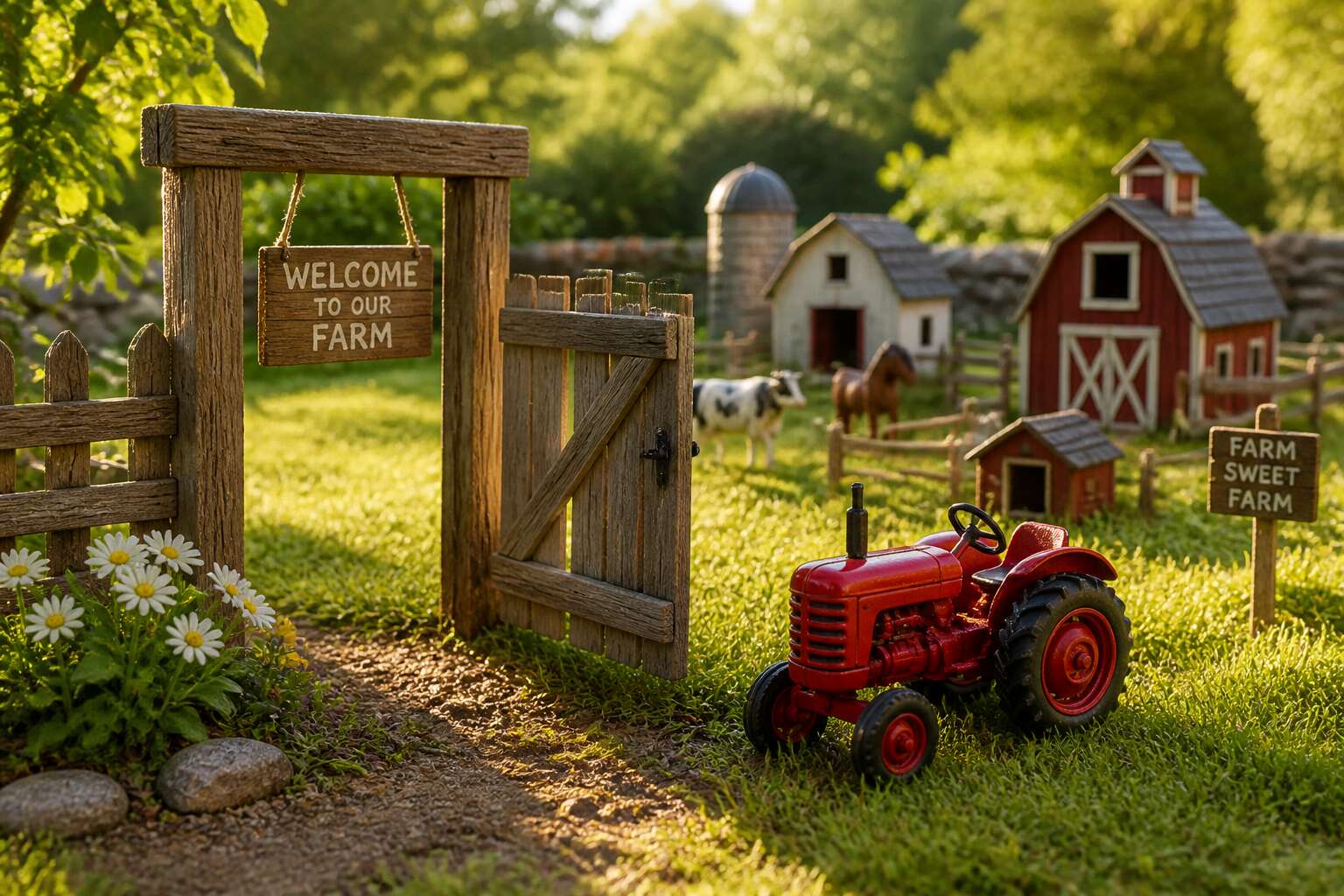
The Allure of Agricultural Playthings
Why Children Are Drawn to Farmyard Elements
A farm gates toy holds strange authority. Children ignore the plastic animals to fixate on the latch itself. That small mechanism triggers something deeper than amusement. It answers a hunger for boundaries. In an open yard, the gate creates the only edge a child can control.
I have seen this compulsion firsthand! A toddler will spend half an hour swinging a gate, testing each click. Psychologists speak of mastery through play, but that feels thin. The real pull is philosophical. The child asks, without words, what may pass and what must stay.
- A gate offers a clean answer.
- It lets a child play warden.
- It turns order into a tangible object.
This is why the farm gates toy endures. It does not simulate farm work. It simulates the power of a border, and that lesson never fades.
The Evolution of Toy Farm Gates Through the Years
Agricultural playthings carry an unusual sense of purpose. The farm gates toy began as a whittled wooden latch, a child’s copy of the barrier that kept cattle in the paddock. By the 1950s, manufacturers pressed them from tin, then moulded them from polymer. Every version preserved the same essential motion: lift, swing, drop.
The evolution across decades was guided by expectation rather than necessity. Early toy gates had simple hooks that rarely closed flush, and children tolerated the imperfection. Modern reproductions offer working hinges, realistic colours and scale-accurate posts, yet they preserve the same tactile lesson. I have watched collectors in South Africa handle vintage wooden originals with a respect normally reserved for tools, while parents today choose polymer sets for resilience and safety. The allure rests in the mechanism itself, a small tool carrying real history.
Materials That Bring Toy Gates to Life: Wood, Plastic, and More
Touch has always decided which objects become meaningful. Consider how a wooden farm gates toy feels compared to its polymer counterpart. Wood retains warmth from small hands, develops a patina from years of grip, and carries the scent of pine or oak. Plastic stays cool, smooth, and predictable. The difference is not quality but character.
Each material introduces its own set of compromises.
- Wood offers authenticity, weight, and a satisfying click when the gate drops into place.
- Polymer delivers durability, resistance to weather, and easy cleaning after muddy play sessions.
- Metal versions provide heft and permanence, though they can dent and rust near water.
South African parents often choose polymer for outdoor sandpits, where sun and moisture attack natural fibres. Collectors gravitate toward timber for its honest wear. The material reveals purpose. A child learns heft, grain, and tolerance from wooden gates. With plastic, the lesson shifts to resilience and adaptability. Neither experience invalidates the other. The farm gates toy becomes a conversation between maker, material, and child. The choice of medium reflects what we want play to preserve. Weight teaches responsibility. Flexibility teaches forgiveness. Both have a place in the paddock.
Developmental Benefits of Incorporating Toy Farm Gates
Boosting Fine Motor Skills Through Gate Manipulation
Watching a child fumble with a stubborn latch reveals a quiet kind of concentration. A farm gates toy becomes a small world of resistance and reward. Each twist of a metal hook or slide of a wooden bolt demands precision from tiny fingers. That precision builds the muscles needed for writing, buttoning, and cutting. A child who struggles with a gate learns to adjust grip and pressure without knowing they are practising fine motor control.
- Hooking and unhooking chains develops the pincer grip.
- Sliding bolts across tracks encourages wrist rotation.
- Lifting drop bars coordinates both hands in opposite movements.
These motions feel like play, yet they train the hand in ways that puzzles and screens cannot. The weight of the gate, the click of the catch, the silence before success. Incorporating a farm gates toy into daily play gives children the repetition they need to master small, deliberate movements. When the latch finally opens, the hands have grown stronger.
Fostering Imaginative and Role-Playing Creativity
A quiet moment of play can reveal a child’s whole worldview. Place a farm gates toy before them and watch a narrative emerge. The gate is not simply a barrier. It is a decision point. Who may enter? What lies beyond? In South African homes, where farm culture carries emotional weight, children project these questions onto their play. They invent scenarios around securing livestock, welcoming visitors, or escaping a sudden storm.
Role playing with a farm gates toy encourages children to negotiate authority. They decide who opens the gate and when. The repeating drama of entry and exit builds social understanding, patience, and the language of cooperation. A child who controls the gate learns that power requires responsibility.
Teaching Cause and Effect with Mechanical Features
When a child pushes a latch on a farm gates toy, the gate swings open. That immediate consequence builds a mental model of cause and effect. The mechanical features reward deliberate action. A small turn of a knob or a pull of a chain produces a visible result.
Repeating these actions teaches prediction. Children begin to anticipate outcomes before they touch the gate. Some designs include weighted bases or spring-loaded closures. These parts demand precise force. Too little force means no movement. Too much force might swing the gate past its stop.
Through this trial and error, a child’s brain maps physical rules. The farm gates toy becomes a quiet lesson in physics, not a loud one.
Encouraging Cooperative Play and Communication
Cooperative play emerges naturally when a farm gates toy requires two hands. One child holds the latch while another guides a plastic cow through the opening. The gate becomes a shared obstacle, and success depends on mutual timing.
Children exchange instructions, announce their next move, and correct one another with gentle authority. This dialogue builds vocabulary around action words like push, lift, and swing. It also teaches the rhythm of conversation, the pause between request and response.
When three children play together, they assign roles without adult intervention. A gatekeeper, a herder, and a lookout. Each role needs speech to coordinate. The farm gates toy turns scattered play into a mini society, one where every voice has a purpose.
Selecting the Ideal Toy Farm Gate for Your Child
Age-Appropriate Designs and Complexity Levels
Nothing frustrates a child faster than a farm gates toy exceeding their grip strength. Select the right one by assessing current motor abilities. Toddlers need a gate that slides with one push. Five year olds enjoy latches opened in sequence.
Use these complexity cues.
- Under three years, pick a single action gate with no small parts.
- Ages three to five, choose two step closures that click.
- Ages six and up, select spring hinges and alignment slots.
The ideal farm gates toy offers a small challenge without frustration. Watch your child’s hands during free play. If they fumble for twenty seconds, the difficulty is too high. If they master it immediately, move up a level. I have seen children reject a toy because the starting complexity was wrong. A toy with interchangeable parts lasts longer, but the starting point decides if it gets played with.
Scale and Compatibility with Existing Toy Sets
Scale determines whether a farm gates toy becomes part of the story or an obstacle. Measure the gaps in your child’s current setup before buying. A gate designed for tiny plastic sheep may block a diecast tractor completely.
Check connector types and base plates. Some gates clip into standard track systems, while others require proprietary fittings. The best choice slots into an existing layout without adapters.
Here is what I check before recommending a gate:
- Door width against the widest toy vehicle
- Latch height relative to the toy farmer figures
- Base shape against your current fencing segments
A mismatched farm gates toy stalls imaginative flow. The right scale invites the animals through, and the play continues without interruption.
Safety, Durability, and Non-Toxic Materials
Every parent in South Africa knows the sun and red dust test a toy’s worth. A farm gates toy must survive being dropped on paving and left outside overnight. I prioritise solid construction over shiny packaging. Children pull, lean, and slam these gates, so ask about impact resistance before you buy.
- Check for rounded corners that protect little fingers
- Confirm the hinges are recessed, not exposed
- Look for a non-toxic finish that survives licking and biting
Durability means less waste, and safety means less worry. Non-toxic materials matter because toddlers explore with their mouths. A well-made farm gates toy uses food-grade plastics or sealed hardwoods. The latch should move smoothly without pinching. That way, the gate becomes a trusted part of play, not a source of tears.
Balancing Price and Quality for Long-Term Use
The price range for a farm gates toy in South Africa can be surprisingly wide. Basic plastic versions sell for under R100, while elaborate wooden sets go for over R500. The difference is not branding. A cheap hinge loosens within weeks. A proper mortise and tenon joint stays tight for years.
Consider how long the toy will serve. A farm gates toy that costs R350 but lasts five years outdoes a R150 version replaced every year. That math matters for South African families. Look for sets that offer replacement parts. Some local manufacturers sell spare hinges and latches, which extends the life of the toy considerably.
- Compare the weight of the gate. Heavier usually means thicker timber or denser plastic.
- Check if the paint is sealed or just surface coated.
- Ask if the manufacturer offers a warranty against breakage.
These details reveal whether you are paying for substance or packaging. A quality farm gates toy should feel like an investment in your child’s play, not a disposable purchase.
Creative Play Scenarios Featuring Toy Farm Gates
Crafting a Miniature Farmyard and Enclosure
Picture an empty tray becoming a working homestead. The change starts with a set of farm gates toy pieces arranged into a kraal and its surrounding paddocks. One gate swung open sends the sheep out for morning grazing, and a second gate clicked shut turns a narrow path into a holding lane.
- Rotational grazing: swap gate positions to move the herd daily.
- Quarantine pen: close one animal behind a rail while the rest run free.
- Tractor lane: widen a section so the machinery can pass without scattering the flock.
These scenarios keep the farm gates toy central to the layout. Every fence line, hinge, and latch answers a small moving problem.
Turning Gates into Obstacle Course Elements
Farm gates toy pieces can anchor a makeshift obstacle course. The task is direct: open the gate, push the load through, and drop the latch before moving on. That order requires both hands to work together, a sense of distance, and a plan for the next step.
Course difficulty scales with the child. One gate acts as a simple starter. Two gates angled against each other force a sharp turn. A third gate introduces sequencing, since the order of opening changes the route.
- Lay gates flat as hurdles for toy tractors.
- Stand two gates side by side to create a narrow corridor.
- Prop a gate at an angle to turn it into a ramp.
Each layout changes the physical challenge. The farm gates toy stays at the center, and a simple hinge becomes a real test of timing and control.
Mixing with Animal Figures and Vehicles for Storylines
Sunset over the Karoo brings a different kind of tension. The farm gates toy stands between the grazing camp and the kraal. A toy bakkie idles on the dirt track, loaded with feed bags. The animals know the routine. The child must swing the gate open, hold it steady, and let the sheep through before the driver can proceed. One hand on the latch, eyes on the moving flock.
Storylines multiply when animals and vehicles share the space:
1. The stubborn donkey refuses to cross, blocking the bakkie.
2. A loose calf escapes through the gap while the gate is open.
3. The tractor must reverse through the gateway without clipping the posts.
Each scenario forces a decision. Does the child direct the vehicle or wrangle the animals first? The farm gates toy absorbs that tension, making the hinge the most important corner of the story.
Role-Playing Farm Life and Daily Routines
Sunrise on a toy farm follows the same rhythm as the real Karoo. The first task is always the gates. In my household, the farm gates toy becomes the centre of morning chores, with the child playing the role of farmhand, checking each latch before the animals move to fresh grazing.
The daily routine unfolds with purpose. Water troughs need filling. The cattle gate must swing open for the herd to reach the dam. Then the small paddock gate closes behind them, keeping the camp secure. The repetition of open, close, latch, check gives the play session a structure that mirrors actual farm work.
Some children prefer to rotate through roles:
- The farmer who manages the gates
- The stockman who counts the animals
- The visitor who must be let through each gate
Each role brings its own set of decisions, and the farm gates toy adapts to all of them.
Maintaining and Extending the Lifespan of Toy Farm Gates
Simple Cleaning and Storage Practices
The South African sun is relentless, and a farm gates toy left outdoors will show it within months. Faded paint and warped wood appear quickly. Maintenance starts with inspecting hinges. Dust gathers in the tiny grooves where wooden posts meet metal pins. A soft cloth and warm soapy water handle most residue, but painted surfaces need extra care, as excess moisture lifts the coating and exposes raw material underneath.
Storing a farm gates toy demands more thought than parents expect. Humidity swells wooden components, and plastic connectors turn brittle in extreme heat, so a dry, cool cupboard works best.
- Small parts survive longer in sealed containers
- Gates stored upright resist warping of connecting rods
- A seasonal rotation distributes wear evenly across the collection
I have found that checking gate joints extends usability. The effort takes minutes, and the toy remains playable for years!
Quick Fixes for Hinges, Latches, and Fasteners
A stubborn latch on a farm gates toy often ends playtime early. A toothpick dipped in cooking oil works wonders on a squeaking hinge, and it costs nothing. For loose fasteners, a drop of clear nail polish on the thread keeps them secure without damaging plastic components.
Assess the wear pattern first. A gate that scrapes on one side usually needs a gentle twist, not force. Try these quick corrections before considering replacement:
- Tighten screws while the gate rests flat, never while suspended
- Apply petroleum jelly to metal pins before the winter damp arrives
- Swap corroded fasteners with stainless steel versions from any hardware shop
I keep a small repair kit near the toy shelf. Every farm gates toy responds well to timely attention, and the fix takes less time than searching for a missing piece!
Repurposing Old Gates for Educational Activities
A farm gates toy earns its place in the playroom through years of hard use, but even the sturdiest gate eventually shows its age. Rather than discarding a weathered piece, consider its second life as a teaching tool. An old gate can become a counting frame for early numeracy, a tracing template for pencil control, or a prop for sorting animal figures by size.
Repurposing extends the lifespan of every farm gates toy while adding fresh educational value. Remove loose hardware and sand rough edges before introducing the gate into new activities.
- Use the frame as a stencil for shape drawing
- Attach hinges to a cardboard box for a working door
- Let children paint the gate to create a custom display piece
These small transformations keep the farm gates toy relevant and meaningful long after its original purpose fades.




0 Comments